Free capture
An immediate take without a corpus
- Inputs
- Microphone, voice, language
- Useful output
- Local WAV + provenance
- Success
- Manual stop, up to ten minutes
PROJECT DOSSIER
Voice Capture Studio is an open-source, local-first browser instrument for capturing, performing, reviewing and segmenting voice across five purpose-built workflows.
VOICE AS AN INSTRUMENT
The interface borrows the calm precision of an acoustic instrument: warm white, black typography, translucent glass, diffuse depth and a filament that only claims to be live when a fresh signal exists.
An immediate take without a corpus
Media transformed into verifiable words
A coherent, comparable and traceable voice
A line performed against picture
A guided performance without contaminating the voice
DECISION FLOW
Browser word and phoneme timing remains explicitly estimated. A forced-alignment import or downstream Forge validation may replace it; the browser does not silently promote an estimate into acoustic ground truth.
KNOWLEDGE EDITORIAL ROADMAP
Each article links product evidence to a wider neighborhood of concepts, technologies, programs and research questions.
01UX / signal
Filament, halo, silence, latency and reduced motion as laws of an instrument rather than app decoration.
Read the complete article02Pipeline / provenance
PCM, observations, quality, persistence, checksums and training manifests without conflating preparation with training.
Read the complete article03Method / trust
How declared corpus, measured signal, optional ASR, estimated alignment, fused decisions and external acoustic validation remain separate.
Read the complete article04Audio / local AI
16 kHz decoding, adaptive VAD, local Whisper, vocal separation, multi-pass consensus and verifiable exports.
Read the complete article05Product / UX
Free capture, ML Dataset, Dubbing, Performance and Lexical Segmentation compared through inputs, gestures and outputs.
Read the complete article06Architecture / web
Web Audio, AudioWorklet, IndexedDB, File System Access, Workers, PWA and progressive capability handling in real browsers.
Read the complete articlePROJECT FRAME
This section gathers the brief, constraints, outcomes and public evidence into one readable project frame.
Voice work usually fragments across recorders, subtitle tools, media players, folders and model-specific scripts. The sound may survive while the prompt, speaker, room, scene cue, review state, timing, provenance and decision trail disappear.
ART DIRECTION
The visual language is documented here as a compact system; project media appears once, in its dedicated hero or documentary gallery.
Local-First Voice Instrument
DEVELOPMENT
The technical read combines approach steps, implementation choices, current constraints and delivery state.
Make the live filament, acoustic halo and review waveform follow fresh measured audio rather than decorative time-based motion.
Preserve corpus, signal, VAD, optional ASR, alignment, evidence and confidence as separate observations before deterministic fusion.
Capture or decode locally, persist through browser storage or a chosen folder, and package open WAV plus inspectable metadata.
Keep React orchestration outside domain modules and publish the implementation, doctrine, audits and deployment workflow as open source.
Public technologies, frameworks and dependencies connected to the project.
MARKETING
This view turns the project into a public-facing offer: who it speaks to, what it promises and what can already be shown.
Voice work usually fragments across recorders, subtitle tools, media players, folders and model-specific scripts. The sound may survive while the prompt, speaker, room, scene cue, review state, timing, provenance and decision trail disappear.
PROJECT READING
Move between strategic framing, context, implementation logic and evidence without losing the surrounding page.
Turn the browser into a trustworthy voice instrument: one calm surface for immediate capture, ML corpus work, dubbing, interpreted performance and local word-level segmentation.
Voice work usually fragments across recorders, subtitle tools, media players, folders and model-specific scripts. The sound may survive while the prompt, speaker, room, scene cue, review state, timing, provenance and decision trail disappear.
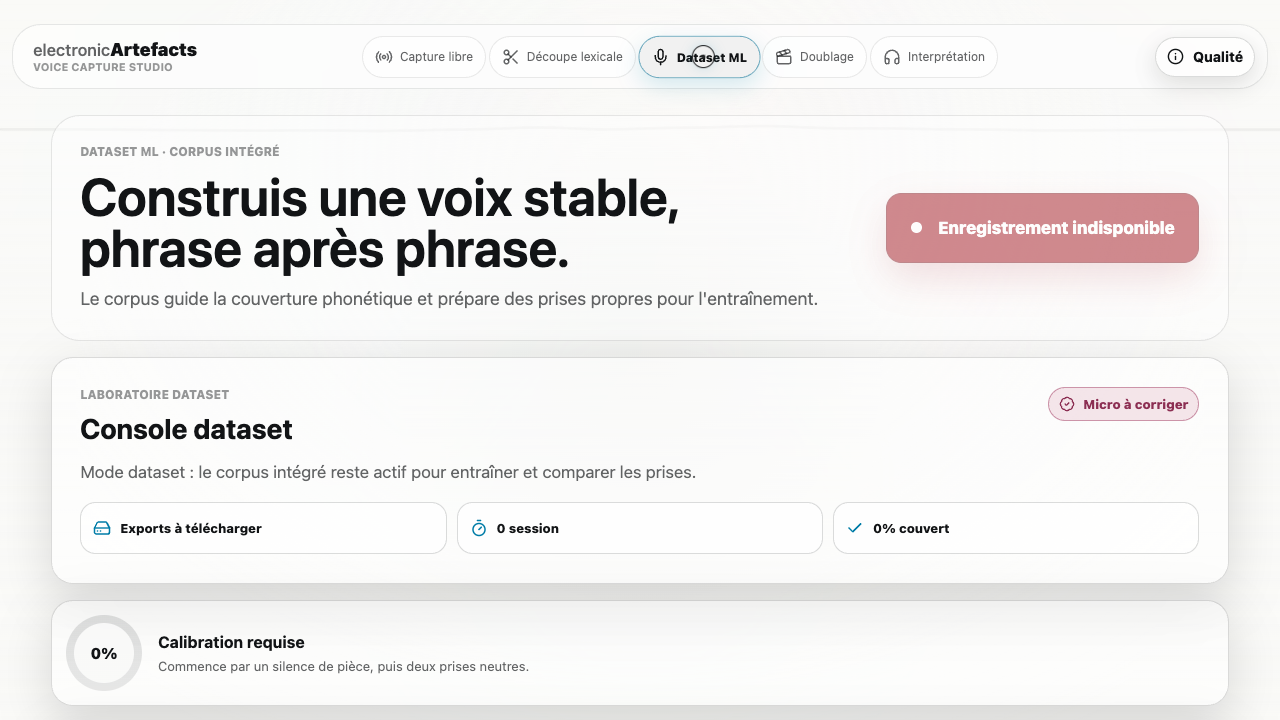
Organize five visible modes by outcome, each with its own inputs, capture gesture, success criteria and useful export.
Make the live filament, acoustic halo and review waveform follow fresh measured audio rather than decorative time-based motion.
Preserve corpus, signal, VAD, optional ASR, alignment, evidence and confidence as separate observations before deterministic fusion.
Capture or decode locally, persist through browser storage or a chosen folder, and package open WAV plus inspectable metadata.
Keep React orchestration outside domain modules and publish the implementation, doctrine, audits and deployment workflow as open source.
The Voice Capture Studio repository contains the open-source five-mode voice instrument, its signal-grounded design constitution, deterministic observation pipelines, tests and GitHub Pages deployment workflow.
OUTPUTS
The Voice Capture Studio repository contains the open-source five-mode voice instrument, its signal-grounded design constitution, deterministic observation pipelines, tests and GitHub Pages deployment workflow.
PRODUCTION
Electronic Artefacts is an independent creative technology studio working through client commissions, proprietary systems and research-led cultural publishing.
MEDIA EVIDENCE
Screenshots, marks, recordings and documents appear here when they help show how the project works.
RELATED CONTEXT
Move from the project toward related people, systems, concepts and evidence.
Electronic Artefacts created Voice Capture Studio as an open-source browser application for local-first speech recording.
PROJECT THESIS
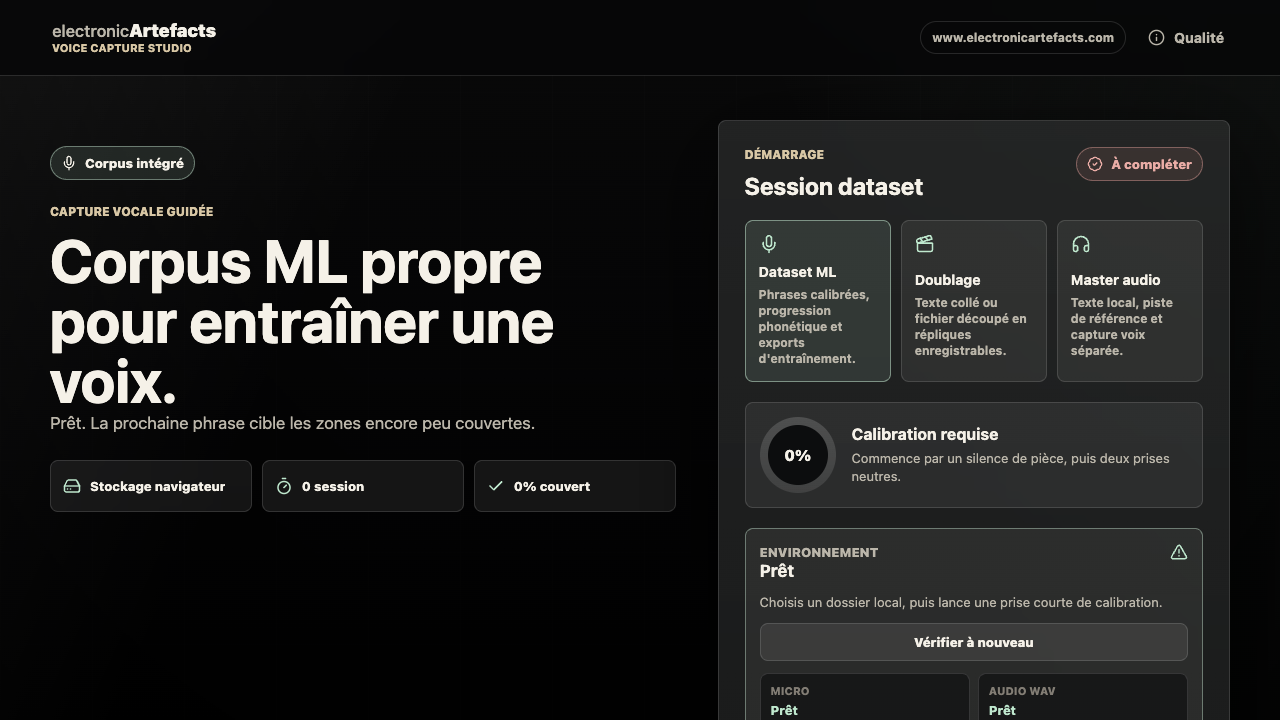
Voice Capture Studio is a local-first voice instrument that runs in the browser. It now joins five distinct workflows in one surface: immediate recording, ML corpus production, picture-led dubbing, interpreted performance with a separate guide track, and word-by-word segmentation of local audio or video.
The application is live at electronicartefacts.github.io/voice-capture-studio and the source code is public at github.com/electronicartefacts/voice-capture-studio.
Voice Capture Studio is the first published application in Studio, Electronic Artefacts’ open-source software line. The connection is a shared operating ethic rather than a shared product shell: specialist tools should be independently usable, local-first where possible, free of advertising, published with inspectable source and able to export durable material into other workflows.
The next planned record, Spatial Mapping Studio, approaches a different material — final 3D payloads and their semantic regions — without changing those commitments. Its V0 work is not an integration with Voice Capture Studio or Forge; it establishes the portable mapping boundary that later workflows can build on.
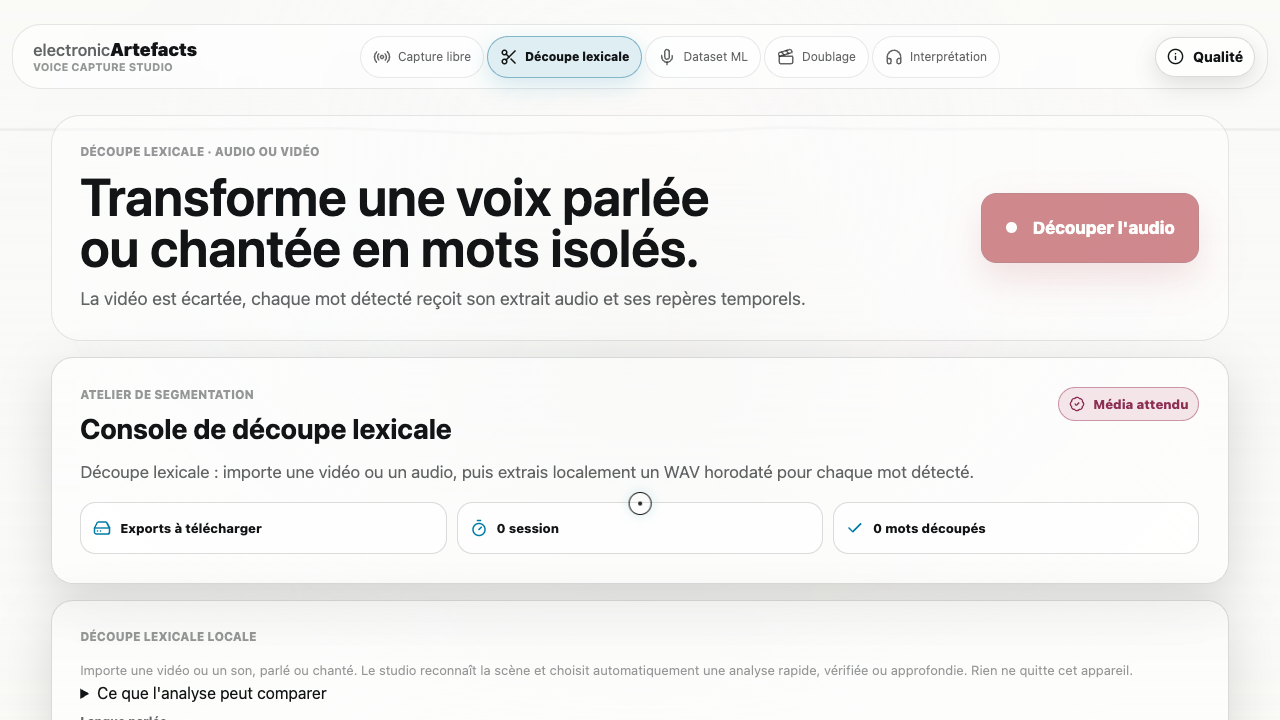
The current interface is deliberately quiet: warm white rather than studio black, large carbon typography, rounded capsules, fine borders, ice-blue focus, dusty-rose warnings and translucent panels that keep the page light while preserving depth. Glassmorphism is used as an information layer, not an ornamental effect: the background stays perceptible while readiness, mode, calibration and export state remain legible.
The main curve — the filament — is the product’s perceptual spine. In the recording application it represents fresh audio, never an arbitrary loop. Its halo derives energy from measured amplitude. During replay, the same visual language follows the decoded take. If a live frame becomes stale, the surface returns to an honest idle carrier instead of presenting old data as current.
That rule extends to the entire motion system: nothing that looks like a reading may be simulated. Silence remains data. Capture receives the full rendering budget. Reduced motion removes choreography without removing meaning. The interface is therefore closer to a pane of glass over an acoustic instrument than to a conventional dashboard.
These are product modes rather than file-format presets. Each changes the inputs, the capture gesture, the definition of success and the useful output. Podcasting remains a Free Capture scenario; voice-over remains a Dubbing scenario; audiobook work remains a Performance scenario until those uses require genuinely different engines.
The recording path begins with progressive capability inspection: microphone permission and inputs, Web Audio, storage durability, folder access, downloads, wake lock, optional speech APIs, Workers and accelerated rendering. A missing optional capability degrades only the workflow that depends on it.
Microphone capture uses getUserMedia and a PCM recorder. It prefers AudioWorkletNode, keeps a ScriptProcessorNode compatibility fallback, encodes mono RIFF-padded WAV at 48 kHz / 24-bit when the runtime permits, and derives first-pass technical metrics from the recorded signal. Imported media is decoded to 16 kHz analysis signals before local segmentation.
After capture, observations remain separate:
This is the deterministic research layer: identical bounded observations feed explicit policies, and uncertainty stays visible. Browser ASR can request review but cannot reject or authorize a physical recording. A transcript mismatch does not erase a technically valid take. An acoustic forced-alignment import can replace an estimated timing map without rewriting the raw evidence.
Lexical Segmentation is the fifth mode and the clearest example of the local pipeline. It accepts up to 200 MB and ten minutes, decodes the media on the device, classifies the scene and chooses a fast, verified or deep analysis budget. A first Whisper pass scouts the source. Difficult speech, singing or music can trigger a base-model pass, a vocal-focus signal, spectral mid/side separation and temporal fuzzy-majority consensus.
Each exported word keeps its start, end, clip context, acoustic support, confidence, consensus votes and evidence class. The ZIP contains 16 kHz / 24-bit mono WAV clips, a versioned manifest and a timeline. Video pixels are not processed by this mode; only the audio track enters the pipeline.
The workspace prefers IndexedDB, can use a user-selected File System Access folder, and always keeps explicit downloads as a fallback. A take cannot credit dataset coverage when its audio was not accepted by durable local storage. Workspace archives are verified before restoration and do not silently overwrite existing WAV files.
The main capture package contains session, speaker and corpus records; take-level WAV, transcript, timing, phoneme, intent, quality, observation and evidence files; dataset reports; a JSONL training manifest; and SHA-256 checksums. Browser estimates remain labeled forcedAlignmentRequired until acoustic validation replaces or confirms them.
Voice Capture Studio prepares material for archives, research, dubbing and machine-learning workflows. It does not train a model, promise research-grade acoustic alignment in every browser or upload private recordings to a remote service.
The app is built with React 19, TypeScript and Vite. Web Audio, AudioWorklet, browser media decoding, IndexedDB, the File System Access API, Workers, WebAssembly/WebGPU-capable local analysis, PWA service-worker distribution and GitHub Pages form the browser chassis.
Domain modules own corpus, sessions, workspace, coverage, recording, observations, phonetics, speakers, settings and export contracts. They do not import React, CSS, DOM or browser APIs. The application shell owns orchestration and adapters. This dependency direction keeps planning, keeper rules, evidence fusion and package contracts testable outside a specific interface.
The repository release gate covers formatting, linting, TypeScript project references, unit coverage, bundle budgets and production build. End-to-end suites exercise capture, responsive layouts, Chromium, Firefox, WebKit, offline restart and automated accessibility checks.
The MIT-licensed repository makes the behavior inspectable. Voice recordings and generated workspaces remain user data; they belong in browser storage, a chosen local folder or an explicit download, never in the public source repository.
Local-first is not a claim that browser storage is permanent. The interface exposes storage durability, capability gaps and export paths because users need to know what will survive a reload, what requires a download and what a particular browser cannot provide.
Useful source entry points:
The six editorial briefs are now complete Knowledge articles rather than release notes: trustworthy audio interfaces, traceable voice capture, deterministic evidence fusion, local lexical segmentation, five mode contracts and browser-native local-first architecture. Each remains useful after interface changes because it addresses a durable problem.
Voice Capture Studio sits near ORETH because both treat audio as structured material. It connects to Web Audio, the Web Audio API, Human–Computer Interaction, Metadata and Open Source as a practical test of those ideas.
The project’s role is precise: make the first voice artifact cleaner, more inspectable and more reusable before an archive, model, dubbing edit or production workflow receives it.
DOCUMENTED RELATIONSHIPS
Each link names the relationship between two entries and why it matters.
Electronic Artefacts created Voice Capture Studio as an open-source browser application for local-first speech recording.
Electronic Artefacts maintains the Voice Capture Studio project, repository and public GitHub Pages deployment.
Voice Capture Studio is published by Electronic Artefacts as an open-source software artefact.
The public GitHub repository provides source evidence for Voice Capture Studio, including code, documentation, tests and deployment configuration.
The Voice Capture Studio repository documents the application architecture, export structure, privacy boundary and GitHub Pages deployment.
The Browser as a Local-First Voice Studio documents Voice Capture Studio as one of its declared subjects.
Deterministic Research: Deciding Without Turning Estimates into Truth documents Voice Capture Studio as one of its declared subjects.
Why Five Voice Modes Need Five Success Criteria documents Voice Capture Studio as one of its declared subjects.
Human Computer Interaction for Creative Tools documents Voice Capture Studio as one of its declared subjects.
Local and Open Source AI Systems documents Voice Capture Studio as one of its declared subjects.
Segmenting Speech and Song Locally, Word by Word documents Voice Capture Studio as one of its declared subjects.
From Microphone to Dataset: Anatomy of a Traceable Voice Take documents Voice Capture Studio as one of its declared subjects.
Trustworthy Audio Interfaces Never Simulate Measurement documents Voice Capture Studio as one of its declared subjects.
Web Audio and Browser-Based Sound Systems documents Voice Capture Studio as one of its declared subjects.
Voice Capture Studio is the lead project in the Voice Capture Studio Collection.
Voice Capture Studio is an explicit member of the Studio collection.
Voice Capture Studio applies speech-recording principles through guided prompts, room-tone calibration, takes and review states.
Voice Capture Studio prepares structured speech dataset material through WAV audio, transcripts, timing, intent, quality metadata and manifests.
Voice Capture Studio applies browser-software principles by running as a static web application with local storage, microphone access and explicit exports.
Voice Capture Studio applies voice-technology concerns around capture, metadata, review, local privacy and downstream workflow boundaries.
Voice Capture Studio supports downstream machine-learning workflows by preparing accepted recordings and metadata without performing model training itself.
Voice Capture Studio applies open-source practice through a public MIT-licensed repository with contribution, issue and documentation surfaces.
Voice Capture Studio applies web-audio practice by capturing and preparing speech directly inside a browser runtime.
Voice Capture Studio applies metadata discipline by attaching transcript, timing, intent, quality and manifest information to recorded takes.
Voice Capture Studio applies provenance concerns by keeping prompt identifiers, corpus versions, speaker context and export manifests visible.
Voice Capture Studio applies HCI principles by making recording modes, environment checks, local storage and quality gates visible before capture.
Voice Capture Studio uses the Web Audio API for browser-local microphone capture and recording workflows.
Voice Capture Studio is listed as a current software or project answer for the research question "How can an AI understand someone during its very first conversation?".
Voice Capture Studio is listed as a current software or project answer for the research question "How can software become explainable through its own knowledge graph?".
Voice Capture Studio is listed as a current software or project answer for the research question "How can speech datasets become reproducible, structured and privacy-first?".
Voice Capture Studio. 2.1.0. Electronic Artefacts, 2026-08-17. https://electronicartefacts.com/projects/voice-capture-studio/